
A health information technology degree is one of the most adaptable qualifications in health care – and that’s exactly what makes it perplexing. The same two-year degree can lead you into medical coding, data analytics, compliance, or IT assistance — and each of those leaves you in a totally different profession with a distinct income, daily routine, and personality.
That bifurcation is a good news / bad news thing. Good news is you are not pigeonholed into one specific role. The bad news is that if you float through the degree without striving for a particular career, you can graduate qualified for everything and prepared for nothing in particular.
This handbook covers the complete playing field. It outlines the kind of jobs you’re actually able to acquire at each level of school, how compensation increases as you go up, the four main specializations and who each one is best suited for, which sectors hire outside of hospitals, and how certifications play into the equation. By the end, you should know not just what the degree can achieve, but what direction inside it fits you.
What a Health Information Technology Degree Actually Teaches
It’s useful to know what you spend two to four years learning before you look at jobs, because the coursework subtly shapes where you land. A health information technology program is at the crossroads of two very distinct subjects: how healthcare works, and how data is handled internally within computer systems.
In healthcare, you learn medical vocabulary, anatomy, disease processes, and the coding systems used to define diagnoses and operations. You will learn health data standards, database basics, privacy regulations, and enough hands-on software training to maneuver easily inside an electronic health record.
That mix is why you see graduates ending up in such wildly different occupations. Some people finish the training and find they prefer the clinical, detail-oriented side of coding and records. Others find they are far more interested in the software, the databases, and the analytics. The surest way of narrowing down the positions below is to see which half pulls at you.
Jobs You Can Get With an Associate Degree
Most people get into this sector with a two-year associate’s degree, and that will open the door to several solid entry-level jobs. You won’t be starting at the top of the salary scale, but you will be working in healthcare and with a far lesser investment than a four-year degree requires.
Most common associate jobs are:
Medical records specialist, assembling and auditing patient data files.
Medical coder – translates diagnoses and treatments into codes for billing purposes.
Health information technologist, ensuring that digital records are accurate and complete.
Medical Billing Specialist- processes insurance claims and payments.
Data entry or abstraction specialist, entering patient info into hospital systems.
Salaries at this level are low to start and increase with experience and certifications. The median annual income for medical records specialists was $51,140 in May 2025, according to the Bureau of Labor Statistics. The lowest earners made less than $37,000, and the top 10% earned over $81,150. That upper band is usually for those who have added certificates or moved into a specialty, which is the pattern you will see repeated across this profession.
The associate path is especially ideal as a testing ground. It gives you genuine experience and cash right away, and from there you can determine if a specialty or a bachelor’s degree is worth pursuing, typically while an employer helps pay for it.
Jobs You Can Get With a Bachelor’s Degree
A bachelor’s degree can get you into managerial and analyst-level jobs that an associate’s degree cannot on its own. This is where you go from dealing with data to interpreting data or dealing with the people who deal with data.
Typical jobs for bachelor’s degree holders are:
Health Information Manager, responsible for records, staff, and workflow in a department.
Clinical data analyst, translating raw patient data into reports that executives may act on.
Compliance officer, ensuring records comply with privacy and code law.
• Clinical systems analyst. Support and development of hospital software.
Revenue Cycle Analyst – Monitors billing accuracy for a whole facility.
The salary is commensurate with the extra responsibility. Many of these positions fall under the Bureau of Labor Statistics (BLS) category of health information technologists and medical registrars, which had a median wage of $68,020 in May 2025, with the top 10% making more than $117,420. The full wage breakdown can be seen in the BLS Occupational Outlook Handbook.
A bachelor’s also helps future-proof your profession. More mundane data entry is being automated. The tasks that remain and flourish are the ones that need judgment, oversight, and communication. This is precisely what this level of the field is based upon.
Jobs You Can Get With a Master’s Degree or Higher
Graduate studies place you in leadership and strategy where you are often managing entire systems rather than a single department. These professions demand a combination of profound technical expertise and genuine commercial and management responsibility, and the remuneration reflects that.
Common advanced jobs are:
Director, Health Information Management Department or system-wide strategy leadership
Chief health information officer, steering technology decisions across a business.
Senior health data analyst responsible for complicated reporting for large health systems.
Consultant in health informatics, assisting hospitals on the selection and upgrading of systems.
This kind of pay can easily exceed six figures, especially in management. Many of these leadership positions fall under the broader category of medical and health services managers, who earned a median annual income of $123,860 in May 2025, and top people at major systems make far more. The downside is that these occupations normally demand an advanced degree and several years of on-the-job experience gained at the lower levels.

The Four Main Career Specialties, and Who Each One Suits
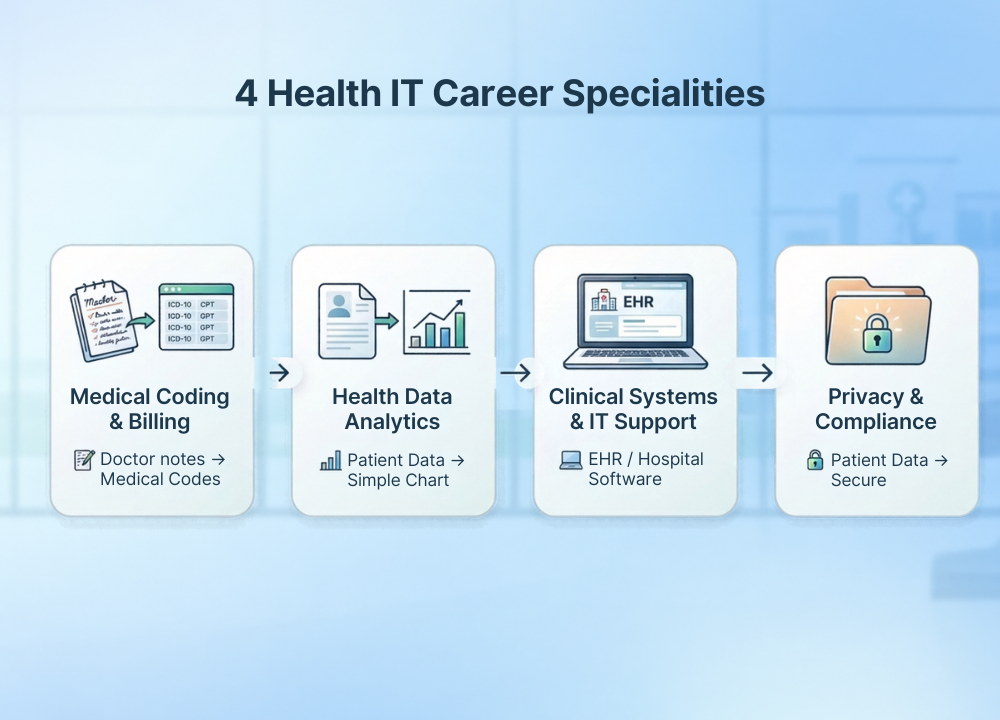
Your degree level will determine the maximum you can reach, while your chosen specialty will determine your real day-to-day work and job title. The discipline is largely made up of four specialties, each of which draws on a distinct slice of the syllabus. When you focus your electives and your first job hunt around one specialty, your CV is far more noticeable to employers since it shows direction rather than just vague availability.
Medical Coding and Billing
Coders review a physician’s notes and convert them into the codes insurance companies need to process claims. It is exacting, rule-bound work that rewards precision and persistence, and it is at the financial core of any healthcare business.
More than any other niche in the profession, this road pays off in certification. The AAPC’s 2025 wage study revealed coders with three or more professional certifications earn an average of around $81,000 a year, significantly higher than the entry-level median. It’s also the most remote-friendly specialty, with the majority of licensed coders currently working at least part-time from home.
The honest caveat that is good to know is that automation is progressing quickest in routine coding. Now, AI systems are auto-suggesting codes, especially in organized spaces like radiology. The coders who remain valuable are those who are moving toward audits, complex inpatient situations, and overseeing what the software is churning out, not racing it on volume.
Health Data Analytics
Analysts find patterns in big collections of clinical and operational data to assist hospitals in cutting expenses, reducing errors, or improving patient outcomes. If you appreciated the technical part of your coursework more than the medical terminology, then you are generally in the right place.
This path depends more on technical abilities like SQL, spreadsheets, and data visualization tools, and those talents translate well outside of healthcare as well. Pay tends to improve quickly when you develop real analytical talent. Experienced analysts at large organizations often move into senior reporting and strategy roles that pay among the highest in the profession outside of pure management.
Analytics is also one of the more future-resistant specialties. Automation creates more data, not less, and someone still has to ask the proper questions of it and explain the answers to decision-makers who don’t talk in databases.
Clinical Systems and IT Support
The core of this specialty is the electronic health record software itself. This includes selection, installation, troubleshooting, and training of clinical professionals to utilize it properly. This is for those who liked the systems and software part of their degree much more than coding or medical terminology.
Here, graduates are interpreters. They’re the ones who sit between the clinical staff, who need the system to work while they’re on a busy shift, and the engineers who designed it. They’re often the person whom a furious nurse calls when something breaks. The work is a lot of technical problem-solving and a lot of patient communication, which isn’t what everyone expects when they go into it.
Since the profession is so related to particular software platforms, becoming an expert in a widely used system can make you truly hard to replace and open openings at both hospitals and the software firms themselves.
Privacy, Compliance, and Health Information Management
This track addresses the safeguarding of patient data and ensuring organizational compliance with all federal privacy regulations. In these environments, compliance officers and health information managers typically have real legal power, establishing regulations, executing audits, and training personnel on how to use data properly.
It will appeal to folks who got more from the regulatory and organizational aspects of their program than the pure data work. This is a position for someone who can read the fine print, keep their cool under examination, and explain intricate rules to others who’d rather not hear them.
This expertise has gotten gradually more significant as breaches and privacy enforcement become more serious, and the leadership posts in this specialty are among the better-paid in the whole industry.
Which Industries Actually Hire Health IT Graduates
One prevalent misperception is that this degree is only for positions in hospitals. That skill set is in demand across many industries, which is a big problem if you don’t reside near a major hospital or want remote possibilities.
Employers, much beyond hospitals, include:
Insurance firms operating claims and member data at scale.
Government and public health agencies that monitor health statistics and outbreaks.
Health-tech and software companies build the tools that hospitals use every day.
Consulting companies enable smaller clinics to modernize their systems.
Long-term care, home health, nursing homes, patient records management.
This is a real strategic advantage. Especially in insurance and software, the firms hire remotely more often than hospitals, so even a person in a small town can create a career in this industry without migrating.
How Certifications Change What You Can Do
A degree will get you your foot in the door, but a certification will often tell an employer what specific occupations you are qualified for and what they will pay you. In this industry, the two go hand in hand, and attaching the correct certification to your degree is the best way to boost your beginning salary.
The most valued certifications for management-track positions are the Registered Health Information Technician (RHIT) and the Registered Health Information Administrator (RHIA). Both are offered through AHIMA, the American Health Information Management Association. The RHIT requires an associate degree from a recognized program, whereas the RHIA requires a bachelor’s degree and is aimed directly at leadership.
If you are going into coding, other certifications matter more. Employers are seeking Certified Professional Coder, or CPC, from AAPC and Certified Coding Specialist, or CCS, from AHIMA, and interestingly, neither of these coding credentials requires a college degree. It’s part of why coding is such a popular entrance point for job changers.
The bigger point is to connect the certificate to the specialization, not to accumulate credentials by chance. A single, well-selected qualification that corresponds to the path you have chosen does much more for your resume than multiple scattered certifications that point nowhere in particular.
How to Choose the Right Path for You
There are so many paths you can take; the useful question isn’t “what can this degree do” but “what do I actually want from my work”. A few honest self-checks narrow it down fast.
If you liked medical language, billing, and rule-following, coding and billing is a perfect fit and has the strongest remote options. If you’re more interested in software, databases, and patterns in data, analytics or clinical systems support might be more your speed. If you were into the privacy law and organizational side, compliance and health information management is your lane. And it leads to well-paid leadership down the road.
Automation is worth thinking ahead a step too. The elements of this sector most vulnerable to AI are the high-volume, routine bits, whereas the sections involving judgment, oversight, communication, and difficult cases are expanding. Steer early to the second group, and you make your whole career more durable.
Frequently Asked Questions
Is a health information technology degree worth it?
Yes, for many people. It’s a reasonably inexpensive, short road into a secure, developing healthcare industry with significant opportunities to specialize and earn more money over time. This is best for you if you favor structure and dealing with data over direct patient care, and if you are prepared to add a certification to get the most out of it.
What is the highest-paying job you can get with this degree?
Those at the high end of the earning scale are often in leadership positions like director of health information management and chief health information officer, with salaries well into the six-figure range. On the expert side, senior data analysts and experienced compliance workers can earn good wages, especially at large health systems.
Can you work from home with a health information technology degree?
Yes, in coding and billing and some analytics areas often. In these industries, remote employment is the norm since 2020; however, most businesses prefer experience and a proper certification before offering a fully remote job, so the first one or two jobs may be in person.
Do you need a degree to become a medical coder?
Not really. A lot of coders go through a certificate program and a credential like the CPC rather than a full degree. You need a degree to open up opportunities and to climb the ladder faster, but that’s one of the easier ways to go into healthcare.
Will AI make this degree useless?
No. But it is changing work. Automation is increasingly taking over mundane data entry and code suggestions; therefore, the roles that are growing are those founded on judgment, oversight, auditing, and complicated decision-making. And by staying specialized like that, you maintain your skills up to date as the tools evolve.
The Bottom Line
A health information technology degree is less a career in and of itself, and more a launchpad into four or five truly diverse careers. The same certificate can land you a job as a hospital data analyst, systems specialist, compliance leader, or remote medical coder, and your journey forward depends far more on your interests and your certifications than on the diploma alone.
The best thing you can do is look at the degree as step 1, not the end. Pick the half of the coursework you like, specialize, match it with the relevant certification, and target the portions of the field that pay for human judgment. Do so, and this degree is one of the better-value entry points into a steady, flexible healthcare career.