
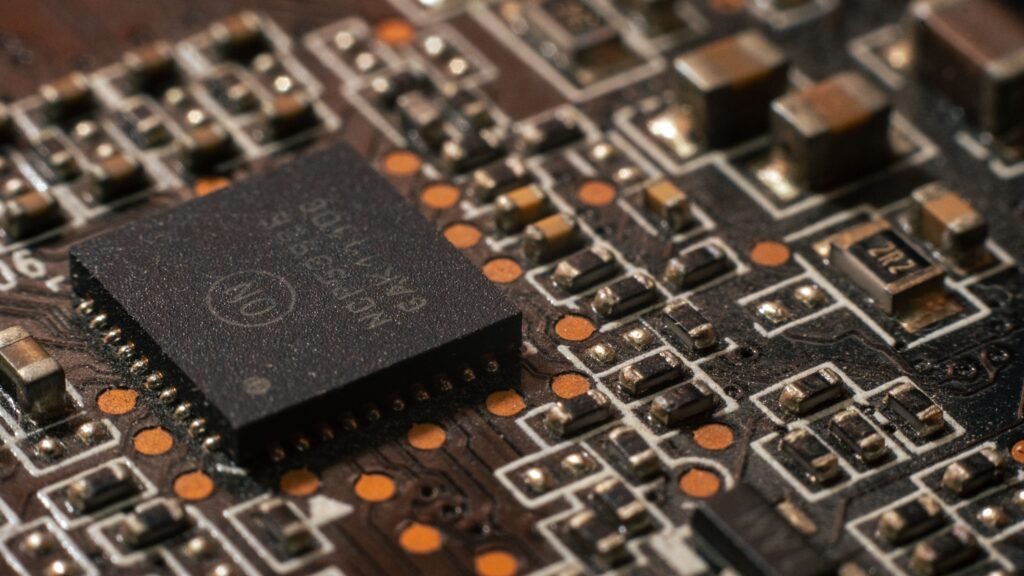
Artificial intelligence is typically thought of as existing solely in software. A model sitting on a faraway server, a recommendation feed, or a chatbot you type into. Because every smart camera, sensor, wearable, or linked gadget requires a real board, a real chip, and wiring designed to transmit that intelligence, that picture omits the portion that makes any of it function in the actual world.
The majority of AI discussions omit this hardware layer, and doing so is costly. If you choose the incorrect configuration, your gadget will lag, run out of power by lunchtime, or shut down as soon as the signal is lost. Hardware is not an afterthought; it discreetly determines whether a smart device is truly helpful or merely a demo that breaks down in the real world.
This article describes what AI hardware actually entails, how the design varies based on where the “thinking” takes place, and how a specialized company like Radiocord Technologies builds these systems from the ground up. The trade-offs, the businesses that rely on this type of hardware, and the things to look out for before entrusting any organization with a hardware project are all covered along the way.
What AI Hardware Actually Includes
AI hardware is fundamentally the physical stack that enables a device to see its environment, make decisions, and take action. The processor that performs the computation, the sensors that provide it with data, the circuit board that connects everything, and the firmware—that is, the low-level software that operates directly on the chip—are some of the key components that make up that stack.
Fit is what distinguishes a real AI hardware setup from picking up a generic development board from the store. A device intended for a quiet hospital room requires different physical toughness, power management, and shielding than one intended for a noisy factory floor. Instead of being tacked on later, those requirements must influence the hardware from the outset of design. It is rare for a one-size-fits-all board to withstand interaction with an actual environment.
Rather than assembling pre-made kits, Radiocord Technologies, a Canadian electrical product design company, says it builds that entire stack from scratch. Its engineering encompasses printed circuit board layout, embedded systems, and radio frequency design with the aim of packing actual intelligence into a compact and effective package that can be shipped and mass-produced.
The Single Biggest Decision: Where the AI Runs
Where the AI model performs its real computing is one of the decisions that influences nearly every other decision in an AI hardware project. This choice affects the device’s price, battery consumption, speed, and ability to operate without an internet connection. Understanding the three primary techniques is essential to comprehending this entire discipline.
Cloud-Connected AI Hardware
Hardware that is connected to the cloud keeps the gadget lightweight and straightforward by shifting the demanding processing to distant servers. The device remains inexpensive and low-powered, whereas the actual model thinks and responds from somewhere else.
When a gadget does not require immediate responses and has a reliable internet connection, this works well. For instance, a dashboard monitoring slow-moving data can wait a moment for a cloud response without experiencing any significant drawbacks. Dependency is the vulnerability. Most of these gadgets are not suitable for anything remote or safety-critical since they become inoperable as soon as the connection is lost until it is restored.
Edge AI Hardware
With no round trip to a server, Edge AI hardware executes the model immediately on the device. Because the CPU on board must perform the actual work within constrained power and memory, this necessitates a much tighter fit between the device and the code. According to Radiocord, this is where it focuses the majority of its engineering efforts, operating machine-learning models on edge devices for offline operation at the silicon level.
Edge is important because of its independence and speed. In a field without a signal, a soil sensor must make local decisions on its own. The same requirement applies to a security camera that needs to report an event as soon as it occurs because any delay of even a few seconds negates its usefulness. The most challenging and important aspect of this type of work is fitting a competent AI model onto limited hardware.
Hybrid AI Hardware
The burden is divided between the two in hybrid configurations. While more complex analysis or long-term data storage is moved to the cloud whenever a connection is available, quick, urgent judgments are made directly on the device. This allows a device to have the best of both worlds: it can continue to operate offline while utilizing more potent cloud models as soon as it can connect to one.
Complexity is the trade-off. Compared to a strictly cloud or completely edge design, a hybrid system requires two sets of logic to function cohesively, which extends both build time and budget. Although it is the most effective strategy, it is also the most difficult to implement correctly.
Comparing the Three Approaches
| Approach | Where It Computes | Best For | Main Weakness |
| Cloud-connected | Remote servers | Simple, connected devices with no urgency | Useless when offline |
| Edge | On the device itself | Remote or instant-response needs | Harder, tighter engineering |
| Hybrid | Split device and cloud | Devices needing both speed and deep analysis | More complex and costly to build |
Who Is Radiocord Technologies?
Sandeep Kamboj launched Radiocord Technologies in 2020 with the very specific objective of assisting entrepreneurs and business owners in transforming a rough hardware concept into a manufacturing-ready product. Before presenting itself as a Toronto-based design firm catering to clients throughout North America and Europe, the firm first relied on embedded engineering skills situated in India, according to its own account and third-party business documents.
The company highlights its embedded and radio frequency heritage as its primary advantage. Many companies that promote AI capabilities begin with software and consider the hardware as an afterthought. When the most difficult obstacles are physical ones like power constraints and signal interference, it is crucial that a team with a foundation in hardware engineering tackles the issue from the other side.
The company claims to have created and manufactured hundreds of devices in more than thirteen industries, including consumer electronics, retail, aviation, automotive, recycling, security, and agriculture, according to business directories like Crunchbase. The breadth of stated experience is important for a practical reason, regardless of whether those numbers are independently audited: a team that has shipped in a variety of industries has probably already encountered the majority of the challenging issues that a new client’s project is likely to encounter, from tight power budgets to extreme temperatures.
How a Custom AI Hardware Development Service Works
Although each build seems different once you are within it, custom hardware projects often follow a fairly predictable path. Knowing the phases enables you to anticipate problems and identify typical areas for project failure.
Concept review and feasibility check. The team evaluates the idea’s technical and financial viability before starting any design work.
Circuit and board design. This entails arranging the printed circuit board and choosing the appropriate parts and processor.
Firmware development. The low-level software that operates the AI model on the selected hardware is written by engineers.
Testing, certification, and compliance. The gadget undergoes testing and regulatory inspections necessary for its intended market.
Scaling to production. Ultimately, the design advances from a functional prototype to mass production.
When all of these phases are managed internally, a project becomes a full-cycle service as opposed to a design shop that releases the client when the schematic is completed. It is theoretically possible for someone to enter with a paper idea and depart with a finished product suitable for production. Additionally, this continuity lessens a common hardware failure point: a design that appears good on screen but needs to be redesigned when a different manufacturer tries to construct it.
Industries That Depend on Edge and Hybrid AI Hardware
Anywhere a gadget needs to make its own judgments without a continual internet connection, edge and hybrid AI technology can be found. The requirement for hardware that continues to function even when the network fails unites all of these domains.
Agriculture: distant sensors monitoring crop health or soil moisture in unconnected fields.
Aviation: real-time weather and traffic data are read by onboard equipment.
Security: cameras that must respond immediately, rather than a few seconds later.
Logistics: monitoring vehicles that pass through signal-poor or nonexistent locations.
Manufacturing:Predictive maintenance systems are used in manufacturing to continuously monitor machinery on the production floor.
Although each of these sectors has its own set of rules and physical requirements, they all have the same fundamental need. The intelligence must reside on the device itself when a lost connection is not a valid justification.
How to Choose the Right AI Hardware Partner
Knowing what distinguishes a professional engineering team from a company that sells generic kits under its own brand is helpful before committing to any company for an AI hardware project. The difference usually becomes apparent with a few pointed queries.
First, find out if they design the circuit boards themselves or if someone else does that. Outsourcing typically results in delays and a loss of control over the finished product, which can lead to issues that are difficult to resolve later. Second, be sure they have produced functional prototypes rather than merely shipping products at actual production scale. A manufacturable product and a lab showcase are two quite distinct milestones, and many impressive prototypes never make it to a factory line.
Lastly, and perhaps most importantly, find out exactly how they manage offline operations. Since software-first companies struggle to run a model reliably on a disconnected device after a product leaves the lab, this one question tends to reveal how much real edge AI experience a team actually has. A team that confidently and thoroughly responds to it is typically one that has already resolved the issue.
Frequently Asked Questions
What is the difference between AI software and AI hardware?
AI hardware is the actual equipment that powers it, including the processor, sensors, circuit board, and firmware, whereas AI software is the model and code that makes choices. While software receives most of the focus, a smart device may be slow, power-hungry, or incapable of operating offline without the proper hardware.
What is edge AI, and why does it matter?
Instead of transferring data to a distant server, edge AI involves executing the AI model immediately on the device. It is important because it enables a device to react quickly and continue operating even in the absence of an internet connection, which is crucial for devices like security cameras and field sensors.
Is edge AI better than cloud AI?
They are both suitable for different jobs; thus, neither is always superior. While edge AI is required when a device needs to respond instantaneously or operate offline, cloud AI is easier to use and less expensive for connected devices that can handle a small delay. When a project requires the advantages of both, hybrid designs incorporate both.
What does Radiocord Technologies do?
Founded in 2020, Radiocord Technologies is a Toronto-based electronic product design company that creates unique hardware from concept to manufacture based on its own materials and public information. It focuses on executing AI models on edge devices, PCB work, radio frequency design, and embedded systems.
What should I ask before hiring an AI hardware company?
Inquire about how they manage offline operations, whether they have shipped goods at actual production volume rather than just prototypes, and whether they design their own circuit boards. A team’s true end-to-end hardware experience can be readily determined by answering those three questions.
The Bottom Line
Only when hardware is designed to support AI will it be practical in the real world. The most crucial choice is where the model actually operates: on the device, in the cloud, or a combination of the two. The CPU, board, sensors, and firmware must all be selected and tailored to the particular task.
This is the gap that specialized companies like Radiocord Technologies fill, transforming a hardware concept into something that can be manufactured while addressing the physical issues that software-first approaches frequently overlook, such as power, interference, and offline reliability. When evaluating a project of your own, pay more attention to the practical issues, such as who designs the boards, who has shipped in large quantities, and how the device functions in the event that the network goes down, rather than the marketing. You can learn considerably more from such responses than from any pamphlet.
Pingback: System Architecture Design for Hardware Radiocord Technologies - Tech Journey Flow
Pingback: Sensors Emerging Technology Coral Hardware Bluetooth - Tech Journey Flow