
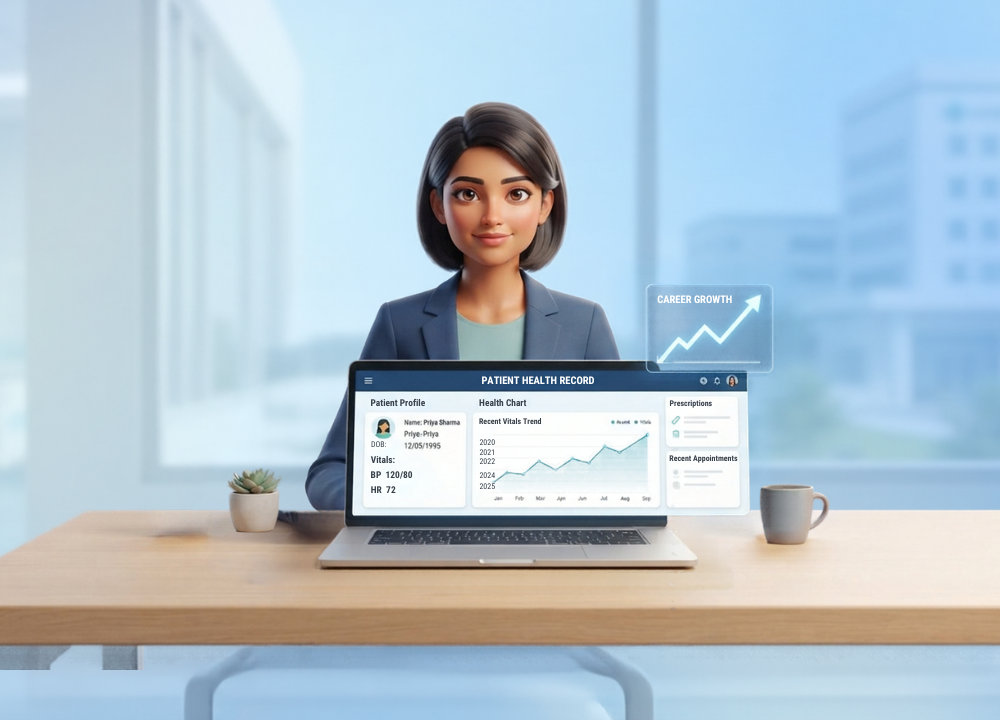
You’re considering a career change, and this profession seems to be on every “fastest-growing healthcare jobs” list you see.
The problem is those lists repeat one inaccurate remark regarding growth and stop there. They don’t talk too often about what the job pays in the long term, what a Tuesday afternoon is really like, or how automation is affecting labor today.
Very is a great gamble to go far on very little understanding. Maybe you spend two years and several bucks earning an education, only to realize that the salary ceiling is lower than you expected, or the job is monotonous.
This guide does just that. It includes real numbers, everyday reality, education and its expenses, the issue of distant jobs, and an honest conversation about whether AI is coming for these jobs.
By the end, you can decide for yourself, not because some headline told you to.
What Health Information Technology Jobs Actually Involve
This career is all about handling the data that keeps a hospital, clinic, or insurer running. The product is information. Your job is to keep it right, hidden, and sent to the right individuals.
This involves filing patient records, verifying the correctness of data submitted, issuing billing codes, and transmitting medical data securely to those who need it.
Some jobs are more technical and include direct work with the software and systems. Others are more about coding and compliance and keeping records in the spirit of federal law.
Very little of it involves any hands-on patient care. You may be behind the scenes, but the accuracy of your job still affects the care a patient receives.
What A Typical Day Actually Feels Like
The daily rhythm does vary a lot by your role, and the differences are more than most guides will allow.
A medical coder’s day is spent looking at clinical notes and translating them into standard codes. Sometimes they have to chase down a physician for missing information before a claim can go out.
A health data analyst spends more time in spreadsheets and dashboards trying to find patterns, creating reports, and answering managers’ questions about rejections or patient trends.
It is the records technician who controls the flow itself, making sure files are full, filed properly, and released only to authorized persons. All three are characterized by one quality: their art rewards patience and precision far more than dazzle.
Job Growth and Demand: The Numbers
Start with the first question everyone asks. Will these jobs still be there in ten years?
The data here is nice. According to the Bureau of Labor Statistics, employment of health information technologists and medical registrars is projected to climb 16% over the next decade, compared to 3% for ordinary occupations.
That’s roughly 3,000 openings a year, for new positions and for personnel retiring or moving on. See the full breakdown at the BLS Occupational Outlook Handbook.
Why Demand Keeps Climbing
Two forces are driving this expansion at once. With the aging of the population, they require more care, and each visit generates data that needs to be handled and preserved.
The second is the relentless digitalization of healthcare and the use of AI tools. Paradoxically, the more the robots automate, the more human workers are needed to supervise, audit, and correct their output.
Entry-level positions are increasing, but not as fast. The typical entry-level job, medical records specialist, is projected to grow 8% over the decade, still above the national average.
What You Can Expect to Earn
One number doesn’t tell you much. Pay varies widely by title, education, and geography. It’s the range; it’s the road that matters.
Health information technicians and medical registrars had around 173,600 jobs in 2025. Half the field made more than that; half made less.
The range is broad. The lowest 10 % earned less than $39830 a year. The highest 10 % earned more than $117420, mostly in specialized and managerial roles.
How Pay Actually Grows Over Time
The honest picture is a slow start, and then a real ascent, and the climb is not automated. It captures credentials and moves.
A new medical records specialist usually starts in the low $40,000s, with a median in the industry of about $51,140 as of May 2025. That’s the price of a low barrier to admission.
A few years and a certification, and coders and analysts are generally in the $60,000s and $70,000s. Top health systems and insurers shell out six figures. Become a manager or director.
The tendency is clear. In this field, you are rewarded for the credentials and skills you add, not just for years on the job.
Common Job Titles and Career Paths
This isn’t a job. That’s a ladder, and where you start has a lot to do with how far you’re willing to climb.
The money and more interesting work are up that ladder. It’s the first rung, not the ceiling, that gets you through the door.
Entry-Level Roles
Most entry-level jobs are as medical records experts and data entry clerks. Many of these positions only require a postsecondary certificate or associate’s degree.
Routine duties include accurate data input, filing, and maintaining the integrity of patient information across platforms.
These roles give you real health care experience and time. You can put more into schooling before you put more on the field.
Mid-Career and Specialist Roles
Medical coders, health data analysts, and clinical systems analysts are in the middle. Typically, a bachelor’s degree or a strong certification is needed for these.
Coders then take those diagnoses and procedures and transform them into standard billing codes. It’s a talent always in demand in just about any healthcare scenario.
Analysts are closer to the software, helping to select systems, clean data, and troubleshoot problems that pop up in day-to-day use.
Leadership Roles
Health information managers and directors are at the top. They manage a department’s data strategy, staff, and adherence to federal privacy rules.
These professions generally demand a Bachelor’s or Master’s degree and multiple years of hands-on experience at a lower level.
Salaries are exorbitant here, typically reaching into the six figures in major systems or insurers. Hence the prior modest years come into play.
Education and Certification You’ll Need
‘Most people begin with an associate’s degree.” It usually takes around two years, and it is a lot less expensive than a four-year program.
The low barrier is one of the key attractions of the field. You can begin earning and testing fit without a huge upfront expenditure.
What The Schooling Actually Costs
Price really does vary by type of school, but it is still rather reasonable compared to most degrees. This is a major advantage to think about.
Average total tuition for an online associate’s degree in health information technology ranges from $5,000 to $25,000. Community-college programs are often affordable, sometimes about $6,000 for students in the district.
For example, if you already have a degree in another sector, a coding or health data certificate can take less than a year and cost a few thousand dollars. It still leaves the door open for entry-level work without starting from scratch.
The Credentials That Carry Weight
Two most crucial qualifications. Both are from the American Health Information Management Association (AHIMA.
The Registered Health Information Technician, or RHIT, must have an associate’s degree from an accredited college. The Registered Health Information Administrator, or RHIA, is management-oriented and calls for a bachelor’s degree.
For coding specifically, certificates such as the CPC from AAPC or the CCS from AHIMA are worth their weight in gold to companies. None of the coding credentials require a college degree.
Very few are required by law. But firms are considerably more willing to recruit skilled people, because the certification shows that there’s a proven level of competency.
Can You Work From Home in This Field?
Yes. And that’s one of the quietest selling points in the business. Almost all of the work is done on a computer; thus, it works quite well with remote arrangements.
Remote coding and billing became standard, not a perk, after 2020. Almost 51% of coders work from home, according to one AAPC compensation poll.
But there’s a catch. The first work or two is on-site, as most organizations want to see real-world experience and a certification before handing out a remote role.
The privacy requirements also regard your home office as part of the health care institution. Wherever you sit, there’s no substitute for safe access and careful management of papers.
Will AI Take These Jobs? An Honest Look
That is the question that hangs over the whole field, and it deserves a direct solution, not a reassuring diversion. The TL;DR: AI isn’t killing work; it’s changing it, but the change is real.
AI is already in the coding loop. In organized specialties such as radiology and emergency medicine, automation already does the bulk of routine charting, while tools that employ natural language processing to evaluate data and suggest codes are also in use.
The BLS itself clearly states that caveat. The agency still anticipates these occupations to expand, not contract, but its projections caution that “demand may be affected by AI-powered solutions.
Where The Jobs Are Actually Heading
The effort is moving from doing everything by hand to checking, correcting, and defending what the machine generates. The professional organizations AAPC and AHIMA have both said that AI is a tool to help coders, not to replace them.
The fastest-growing niche is coming out. The coder looks at the AI’s output, disentangles confusing documentation, and handles the complicated edge cases that software still struggles with.
Some corners are more difficult to automate than others. AHIMA said that these types of employment appear to be more sustainable, given that the volume of documentation and complex logic makes inpatient coding a challenging task for autonomous engines.
How To Stay On The Safe Side Of It
But the most vulnerable coders and analyzers are those who undertake high-volume, repetitive work with clean documentation. That’s where machines are best.
To remain valuable, you need to advance toward the tasks that machines find hard. Human judgment is beneficial in auditing, compliance, denial management, clinical documentation improvement, and inpatient coding.
“Fluency with AI-assisted tools is fast becoming part of the job, not a threat to it. Those who learn to work with software will outlive those who don’t.
The Upsides of This Career
This is one of the few fields that offers security and flexibility as opposed to most career choices. That’s the essence of its appeal.
Some of the key benefits include:
Steady healthcare business. Jobs. Never go down.
A cheap, quick route to a first job, often only two years.
Remote employment with a credential and expertise is a really good possibility.
Space later for code, analytics, privacy, or management.
A field that actually embraces career changers, not just fresh grads.
“You won’t find that combination of health care and tech skills anywhere else.” Demand continues to increase because of that mix, which is one of the big reasons.
The Downsides You Should Know
Every career has trade-offs, and this one has some that are worth serious consideration before you put time and money into it.
The real problems are:
The pay when you start is less than you would make in comparable tech-adjacent jobs.
Long hours at a screen. Not for everyone.
Strict privacy regulations that make everyday tasks into burdens and red tape.
If you don’t actively pursue a certification or degree, your pay growth will be slower.
The ongoing struggle to unlearn skills when AI assumes the mundane aspects of the job.
Most of them diminish as you climb the ladder into mid-career and leadership positions. But the early years might be slow and less lucrative than the sparkling headlines would have you believe.
A Quick Note for Readers Outside the US
The pay and credential numbers above are U.S. based and related to BLS and AHIMA. But in many nations the whole picture is still present.
“Most industrialized health systems are moving to digital records and hiring staff to manage that data, so the demand extends far beyond the US. It’s just other names and numbers for the credentials and the pay.
Remote employment also provides some opportunities beyond boundaries, as companies in revenue cycle and coding are recruiting more and more globally. Local limits on patient data, licenses, and which certifications employers trust differ widely, so it’s worth checking with your local country’s health information association before you commit.
Is It the Right Fit for You?
The truth is, health information technology is a really great career for the right person. But not everyone is for everyone.
It is for individuals who want order, accuracy, and problem-solving rather than direct touch with patients. It also benefits folks who want consistent demand without having to earn a four-year degree right away.
It’s a worse fit if you want to get to a huge pay in your first couple or three years. That kind of advancement happens later, and only when you get qualifications, specialize, or go into management.
Weigh it against what you really want from your job. If the thought of continuous demand, low startup costs, genuine remote flexibility, and real long-term growth potential excites you, then this profession is worth serious consideration as your next career move.