
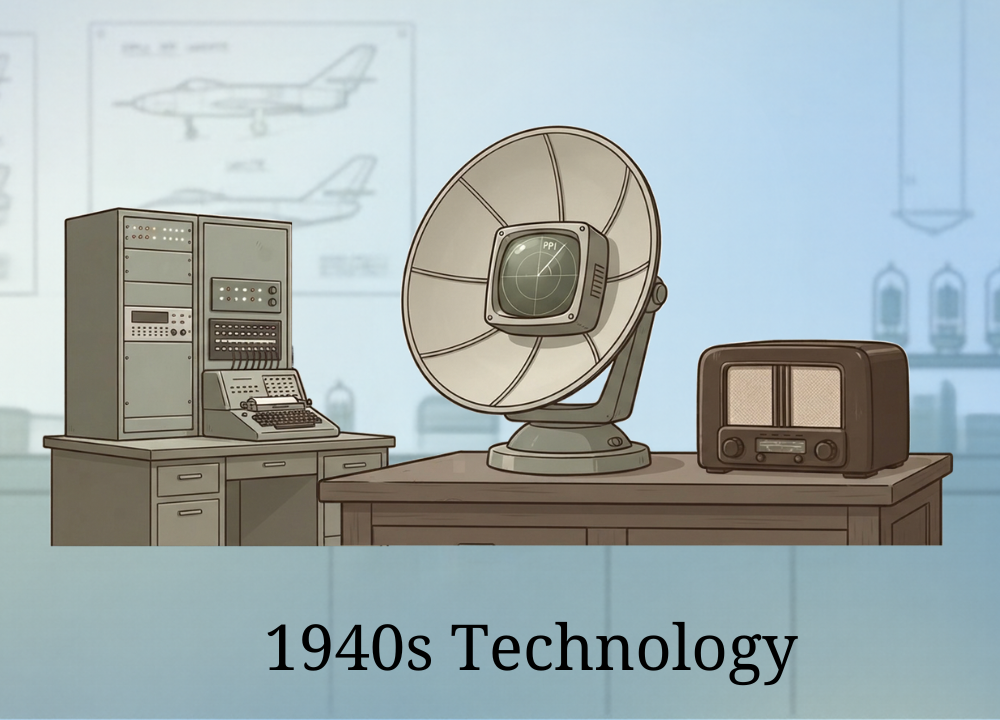
People like to think of the 1940s as a plodding, dusty age before genuine technology arrived. That picture is just incorrect.
It was a decade of conflict and invention and rebuilding, one of the most rapid spurts of change in human history. The exigencies of a world war have driven states to engage in research on a scale never demanded in quiet times.
Radar, jet engines, antibiotics, the first true computers–they all became important problems; no country could ignore them. When the battle ended, those same breakthroughs made their way into everyday homes, hospitals and factories.
If you’ve pondered what really occupied homes, battlefields and labs this decade, the answer goes much deeper than most people imagine.
This guide takes you through every facet of 1940s technology, sector by sector. It reveals the real tools and methods, so you get the full picture, not just a few famous highlights.
Did Technology Exist in the 1940s?
Yes, and in many sectors it moved quicker than in virtually any decade previously. “No digital” is commonly confused with “no technology,” but they are two quite distinct things.
The 1940s ran on mechanical parts, analog impulses, and blazing vacuum tubes, not silicon chips. That didn’t make the machinery any easier. It made it a different type of complicated.”
The war saw scientists resolve in months problems that ordinarily took years. More than anything else, that sense of urgency dictated the pace of tool-building during the decade.
So to call the 1940s “primitive” is just plain wrong. “It was real engineering, for a decade, just created out of materials nothing like the ones we have in our pockets now.
What Was Technology Like in the 1940s?
Think of a typical household in that decade. In the kitchen, a wood or coal burner; in the living room, a large radio cabinet and an icebox kept cold by real blocks of supplied ice.
Now imagine a government research lab, same year. The difference between the two was huge.
Radar systems, aircraft prototypes, and room-sized computers were being built in military and academic labs. Almost none of that made it to the typical household, and much of it was kept classified for years.
Rationing pushed the divide even deeper. Metal, rubber, and electronics went into the war effort, so citizens had to make do with older gear and significantly fewer new purchases.
Two extremely different technical realms coexisted side by side. One shot forward on wartime financing, the other waited patiently till peace and manufacturers returned.
Military Technology and Equipment
The war spurred engineers to tackle issues at a record pace, and the outcomes permanently changed modern defense. You could trace almost every important system of the decade back to a wartime need.
There were tools to see the enemy before the enemy spotted you. Others were for shooting from afar off, or for cracking secrets the adversary thought were safe.
Radar, Sonar, And Early Warning
Radar detected approaching aircraft and vessels, offering valuable minutes of notice for militaries during air raids. That head start altered the way the countries kept their airspace safe.
Sonar accomplished comparable job under water. It allowed submarines and destroyers to locate enemy ships lurking beneath the surface. It transformed the ocean from a space of obscurity to one of legibility.
Both technologies were so beneficial they never went away. These same basic ideas are being used today in air traffic control, forecasting the weather, and ship navigation.
Jet Engines, Rockets, And Atomic Power
The first operational jet fighters to take to the sky were Germany ‘s Me 262 and Britain ‘s Gloster Meteor , both powered by jet engines . Propellers still reigned, but the future had here.
Germany’s V-2, first fired in 1944, was the world’s first long-range guided missile. Its design later fed directly into the rockets that would take people toward space.
In 1945, the Manhattan Project gave nuclear weapons and atomic energy to the world. That single program changed warfare and eventually global electric power generation.
Codebreaking And Battlefield Machines
At Bletchley Park in Britain, a machine dubbed the Bombe assisted codebreakers to decipher encrypted German messages. Reading enemy orders cut the conflict short and saved countless lives.
Over the decade, tanks and armored vehicles had become harder and faster. In invasions like as D-Day, troops were taken directly onto beaches in amphibious landing boats.
Both had a problem that older equipment just couldn’t deal with. The battlefield required new tools, and engineers provided them at a breakneck pace.
Civilian and Domestic Technology
Militarily the labs modernized at a significantly faster clip than the average dwelling. What would have seemed old in a research facility would have sat in a living room of the 1940s.
Family life centered round tube radios which brought news, music and wartime briefings. Home phones were linked by switchboard operators , not direct-dialed on rotary phones .
Iceboxes gradually gave place to early electric refrigerators, while many houses still got ice delivery all decade. Washing machines vary from hand-cranked to early electric.
Many kitchens, especially in the country, were still heated by coal and wood stoves. There were modern appliances, but they were far from universal.
How Rationing Held Homes Back
The war’s constraints diverted metal and rubber to the military first. Appliance manufacturers have little material and few new goods to sell.
Peace came in 1945, and the logjam was broken. Factories were converted in a hurry and electric equipment such as refrigerators and washing machines proliferated in the following years.
Medical and Scientific Equipment
The 1940s saw medicine take great leaps, partly due to the urgent demands of wounded soldiers. Laboratory research helped turn battlefield pressure into life-saving technologies.
The conflict has left hardly any other field so much changed as this. Many of these innovations still form the backbone of everyday medicine.
Penicillin Goes From Curiosity To Cure
During the decade, penicillin went from laboratory curiosity to mass-produced drug. The actual discovery was not the key, but a manufacturing breakthrough.
The world’s first large-scale penicillin production opened March 1, 1944, converted by Pfizer from an old Brooklyn ice plant. It employed deep-tank fermentation, a process that produced the drug in amounts never before experienced with other methods.
Timing was the most important thing. That one plant in Brooklyn produced most of the penicillin that the Allied forces brought ashore on D-Day, and it went on to save millions.
Then streptomycin came, another antibacterial milestone later in the decade. It worked on tuberculosis, a condition penicillin couldn’t touch, and that put these new medications to work.
Machines That Kept Patients Alive
Blood banks multiplied and expanded, enabling hospitals to store and move donated blood for transfusions on a scale never before possible. That power opened new avenues for surgeons to explore.
The iron lung became a life-saving device for polio victims. This enormous mechanical ventilator breathed for those whose chest muscles were immobilized by the sickness.
Too developed research instruments. The first electron microscopes revealed structures significantly smaller than those seen using light microscopes, and cyclotrons were employed to speed up particles for investigating atoms and nuclei.
Communication and Entertainment Technology
AM radio dominated communications and entertainment throughout the decade. Families gathered around large cabinet radios to hear the news, comedy and music.
The radio was the heart of the home in a way that is difficult to imagine now. It was television, the newsfeed, the concert hall all at once.
There was television, but not much. Before the days of broadcasting, only a few wealthy families, primarily in large cities, had experimental sets.
Recording, Broadcasting, And The Battlefield
Reel-to-reel tape recorders were used by the military and early civilians. Sound could now be recorded and played back outside of pressed records for the first time.
Public speaker systems shrieked announcements through businesses, rail stations, and military locations. Field telephones were also used at the front to connect soldiers in between trenches and command posts via portable wired connections.
For most individuals, the overseas conflict came through newsreels. These shorts were shown before the feature in cinema theaters, and they were the principal visual window into far-away battlefields.
Computing and Early Electronics
This decade quietly established the foundation for every computer running today. The devices were big and uncommon, but the concepts in them were forever.
None of these was sitting in houses or offices. They occupied entire rooms, with thousands of vacuum tubes and were owned only by governments and institutions.
Colossus Breaks The Code
In 1943 and 1944, British codebreakers created Colossus to help break German military communications. It used vacuum tubes , and could process data faster than any mechanical device .
Colossus established that electrical machines could accomplish real work with real stakes. The proof was as important as the code it broke.
ENIAC And The Birth Of Modern Computing
ENIAC was the first electrical, general-purpose, programmable digital computer, built between 1943 and 1945 at the Moore School of Electrical Engineering at the University of Pennsylvania. It was principally supported by the U.S. Army to compute artillery firing tables.
It is hard to grasp the size. The machine weighed around 30 tons and had some 18,000 vacuum tubes . It was unveiled to the public in February 1946 . Britannica has an article about ENIAC .
Another milestone machine was the Harvard Mark I, which solved difficult equations using mechanical relays and electronics. It represented the traditional approach, while ENIAC pointed toward the future.
All subsequent computers were defined by the ideas these machines brought to the table, especially the stored-program notion. The hardware was basic. The design was not.
Transportation and Industrial Equipment
In the 1940s, transportation took a severe turn from purely mechanical designs to the first electrically assisted systems. The battle called for increased vehicle movement, faster and farther.
The changes swept across the sky, the rails, the water and finally the driveway. Much of what had been military hardware became civilian routine in a few years.
Late in the decade jet engines started to creep in, although the skies were still dominated by propeller aircraft.
Steam engines on several rail lines were replaced by cleaner and more efficient diesel-electric locomotives.
Mass-produced Liberty ships kept wartime supply lines open across the Atlantic Ocean.
After the war, Jeeps and other military vehicles found second lives as civilian transportation.
That retooling was the engine of the postwar boom. Factories that had made bombs now made cars, refrigerators and radios for returning families.
But it wasn’t only about new items. It was about turning a giant war industrial apparatus into a consumer economy virtually overnight.
What Technologies Were Invented in the 1930s, 1940s, and 1950s?
Looking just at the 1940s shows only a part of the narrative. It makes a lot more sense when you put the decade between the ten years before and after it.
The 1930s gave birth to the 1940s. That preceding decade brought us FM radio, nylon and the first radar prototypes – but primarily as research projects, not finished products.
War strain drove those crude concepts into workable form. Radar became a need for defense, while computers like ENIAC translated computing theory into tangible hardware.
Then, in the 1950s, these innovations reached the everyday consumer. The technology and manufacturing know-how of the 1940s gave us transistor radios, commercial television and the first satellites.
So the 40s were a kind of bridge. They took the designs of the 1930s and transformed them into systems the 1950s could downsize, improve, and market to the public.
How Has Technology Changed Since 1940?
The difference between equipment of the 1940s and those of today can hardly be overstated. The change is not so much slow as stupendous.
Transistors replaced vacuum tubes. Vacuum tubes were the glowing glass bits in radios and early computers. Then transistors were miniaturized and made into microchips, cramming millions of components into a sliver of silicon.
ENIAC weighed about 30 tons and occupied a room. The smartphone in your pocket today has a lot more computational capability than those room-sized mainframes, and it’s shrunk down to fit in your pocket, all within the last century.
Communication followed the same trajectory. TVs replaced radio cabinets, then How Home Internet Actually Reaches Your House the internet and now devices that merge it all onto one screen.
Medicine also kept pace. The wartime mass manufacture of penicillin kicked off decades of novel antibiotics, vaccines, and imaging techniques, much of it founded on procedures established in the 1940s.
Why 1940s Technology Still Shapes the World We Live In
Strip away the decades of refining, and a surprising amount of modern living may be traced back to concepts born or accelerated in the 1940s. And thus the bones of the present were set down.
Without machines such as ENIAC and Colossus, computing as we know it would not be possible. They showed that you could do electronic, programmable math. That evidence is the grandparent of every laptop and server today.
The first use of nuclear energy was the Manhattan Project . Today, nuclear energy generates a large share of the world ‘s electricity . Jet propulsion, created for combat fighters, now ferries millions of passengers over the oceans every day.
Radar was used to track oncoming bombers. Now it controls air traffic, predicts the weather, and leads ships at sea. Penicillin and its descendants remain front-line medicine while newer medications come alongside them.
Few decades have seen so much fundamental change in such a short period of time. The 1940s were never about intriguing gadgets. They made the frame of the modern technological world and we are still living in the edifice they built.